Stimming as an Adult: Why You Do It, Why You Hide It, and How to Do It Discreetly

If you bounce your leg through every meeting, twist a ring until your finger aches, or hold perfectly still all day and collapse the moment you get home, this is about you. Stimming is not childhood behaviour that people grow out of. Most adults stim constantly, they simply learned to hide it. This guide explains what stimming actually is, why suppressing it costs so much, and how to give your body what it needs without anyone at the table noticing.

What is stimming?
Stimming is short for self-stimulatory behaviour: repeated movements, sounds or touches that help regulate your nervous system. It is something every human body does. It becomes more visible, more frequent and more necessary when a nervous system is dealing with more input than it can comfortably process.
Stimming, defined
Stimming is repetitive movement, sound or sensory input that a person uses to regulate their nervous system. It can look like rocking, hand movements, leg bouncing, hair twisting, humming, tapping, or rubbing a texture between the fingers. It serves a function: it discharges tension, sharpens focus, or steadies the body when input becomes overwhelming. Stimming is a recognised feature of autism and is also common in people with ADHD, in highly sensitive people, and in the general population under stress.
Stimming or fidgeting: is there a difference?
The two words are often used interchangeably, and the movements can look identical from the outside. The difference lies in what the body is doing with them.
| Stimming | Fidgeting | |
|---|---|---|
| What drives it | Regulation: too much or too little sensory input | Restlessness, boredom or a need to concentrate |
| How it feels | Often necessary, sometimes urgent | Optional, easy to stop and start |
| What happens if you stop | Tension builds and finds another outlet | Usually nothing much |
| Who it is associated with | Autistic and ADHD people, highly sensitive people, anyone under sustained stress | Everyone |
In practice the line blurs, and it does not matter much what you call it. What matters is the last row of that table: if stopping causes pressure to build somewhere else, your body is asking for something, not misbehaving. If you mainly recognise the need to keep your hands busy, our article on why you always need to fidget to feel calm goes into that side of it.
Adult stims you might not recognise as stimming
Most adults who stim do not think of it that way. The obvious versions get noticed in childhood and trained out. What remains is quieter and easier to explain away as a habit.
- Bouncing a leg, rocking slightly in a chair, or shifting weight foot to foot while standing
- Twisting a ring, clicking a pen, picking at nails or cuticles
- Twirling or stroking hair, rubbing an earlobe
- Running fingers over a fabric texture, a seam, or the edge of a sleeve
- Humming, throat clearing, repeating a word or phrase under your breath
- Chewing: pen lids, the inside of a cheek, gum, cords
- Tapping fingers in a fixed pattern, or counting steps
Repetitive motor movements are listed in the DSM-5 among the diagnostic features of autism, which is why stimming is most discussed in that context. But the behaviour itself is not exclusive to any diagnosis. Plenty of people arrive at this page because they simply cannot sit still in meetings and have started to wonder why.
Why suppressing it costs more than you think
Most adults have learned to hold still. In autistic communities this is part of what is called masking or camouflaging: consciously managing your body, face and voice to appear more typical. It works, socially. It is also expensive.
Research on camouflaging consistently links it to exhaustion, lower wellbeing and higher rates of burnout, because it runs as a background task all day. You are doing your job and simultaneously monitoring your own hands. That second task never gets logged in your calendar, but it uses the same energy.
The pattern many adults describe: a controlled day at work, then no capacity left for anything in the evening. The tension did not disappear during those meetings. It was stored.

Seven ways to stim discreetly
The goal is not to stop. It is to move the stim somewhere that costs you nothing socially, so your body gets the input without your attention being spent on hiding.
- Move it below the table. Foot and leg movements are invisible in most seated settings. Pressing your feet into the floor in a slow rhythm is a full-body stim nobody sees.
- Use something you are already holding. A pen, a cup, a lanyard. Handling an object that belongs in the room reads as normal.
- Put the stim into your clothing. A drawstring, a cuff, a seam or a bead gives texture and repetition at chest height, where hands naturally rest.
- Choose silent over audible. Clicking and tapping draw attention; pressing, rolling and stroking do not.
- Build in scheduled movement. A two-minute walk between calls gives your nervous system a legitimate outlet before pressure accumulates.
- Use pressure instead of motion. Pressing palms together, crossing arms firmly, or leaning back into a chair delivers deep pressure input without visible movement.
- Stop masking where you safely can. At home, in the car, with people who know you. Not every hour needs managing, and the unmasked hours are what refill the tank.
Looking for quiet options per situation, from video calls to open-plan offices? Read our guide to fidget toys for adults at work.
Why wearable stims work better than fidget toys for adults
Handheld fidget toys solve the sensory problem and create a social one. You have to take the object out, it is visibly a fidget, and it can be lost, dropped or left at home. In a meeting room that is often enough friction to stop you using it at all.
Clothing avoids all three. It is already on your body, it does not announce itself, and there is nothing to remember. Hands resting near a drawstring look like hands resting near a drawstring.
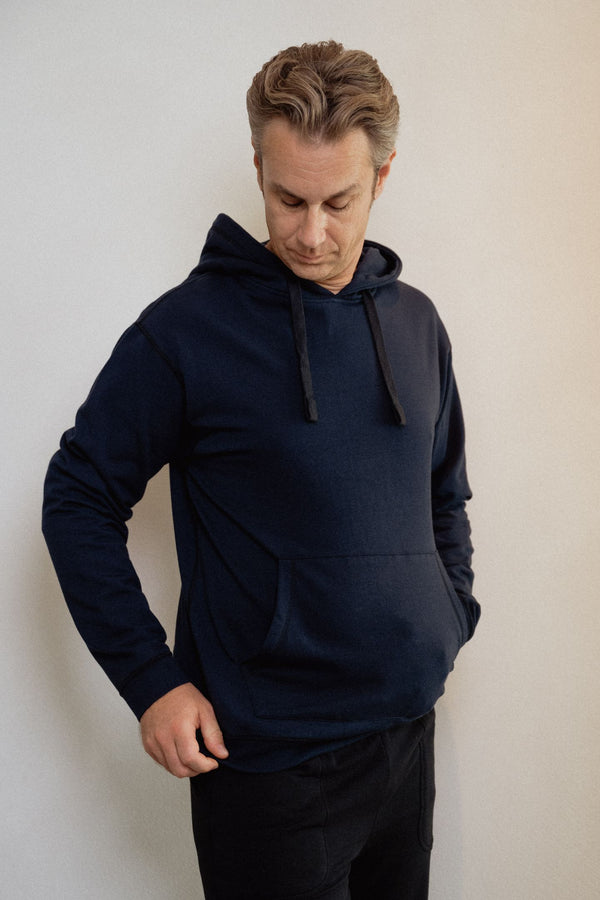
That is the reasoning behind the Blusss FidgetFocus Hoodie: a smooth bead set into the drawstring for rolling and pressing, loops inside the pocket for adding your own fidget, and the rest built like any other sensory friendly garment, with no labels, soft seams and a fabric chosen for long wear. It runs from XS to XL and is made for teens and adults. It shares its fabric with the Calm Jogger, so the two work as a set on days that ask a lot of you.

When to look for support
Stimming itself does not need fixing. If a stim is causing injury, damaging your skin or teeth, or getting in the way of things you want to do, that is worth raising with an occupational therapist or your doctor. The approach in that case is redirection, finding an input that meets the same need more safely, rather than suppression. Suppression tends to move the problem rather than solve it.
Frequently asked questions
What is stimming in adults?
Stimming in adults is repetitive movement, sound or sensory input used to regulate the nervous system. In adults it is usually subtler than in children, because most people have learned to hide the more visible forms.
Is stimming only an autism thing?
No. It is a recognised feature of autism and is discussed most in that context, but people with ADHD, highly sensitive people and people under sustained stress stim too. Everyone does it to some degree.
Is it bad to stim?
No. Stimming is a regulation strategy, not a symptom to be removed. The only reason to change a stim is if it causes physical harm, and then the goal is a safer replacement rather than stopping altogether.
What is the difference between stimming and fidgeting?
Fidgeting is optional and easy to stop. Stimming meets a regulatory need, so when you suppress it the tension usually reappears somewhere else. The movements themselves can look identical.
Why do I only notice my stimming as an adult?
Many adults are diagnosed late, or never, and have spent years masking without a word for it. Learning the term often reframes a set of habits you thought were nervousness or bad concentration.
How can I stim at work without people noticing?
Keep it below the table, silent, and attached to something that already belongs in the setting. Clothing details such as a drawstring bead or a soft cuff work particularly well because they need no explanation.
Does suppressing stimming cause burnout?
Masking, which includes suppressing stims, is consistently associated with exhaustion and lower wellbeing in research on autistic adults. It is not the only factor in burnout, but it is a constant background cost.
Sources and further reading
- The National Autistic Society: guidance on stimming, masking and sensory differences in autistic adults.
- American Occupational Therapy Association: background on sensory processing and self-regulation in daily life.
- American Psychiatric Association, Diagnostic and Statistical Manual of Mental Disorders, fifth edition, which lists stereotyped or repetitive motor movements among the diagnostic criteria for autism spectrum disorder.
Key takeaways
- Stimming is regulation, not a habit to break. Adults stim as much as children, just more quietly.
- Suppressing it is not free. Masking runs all day in the background and shows up later as exhaustion.
- The practical fix is relocation, not removal: silent, below the table, or built into what you are already wearing.