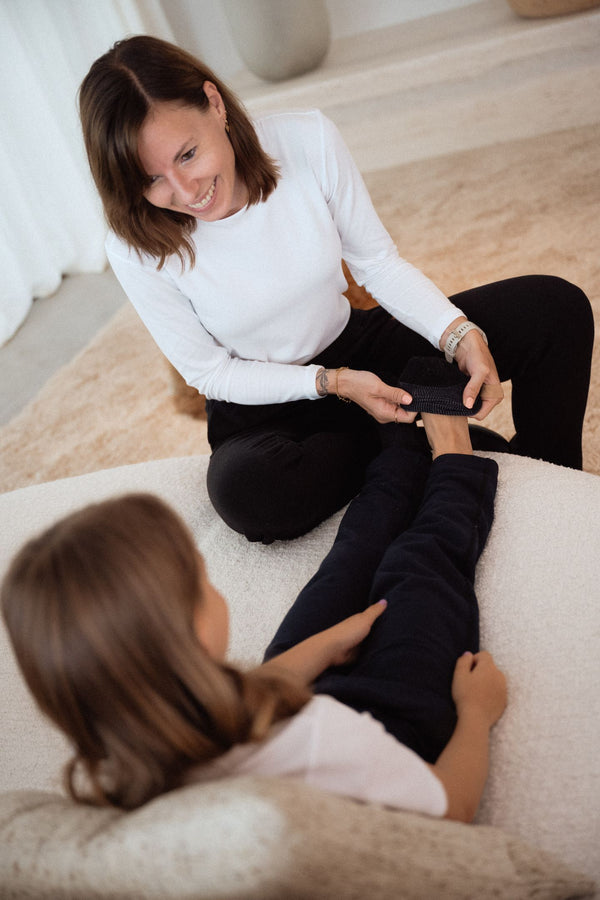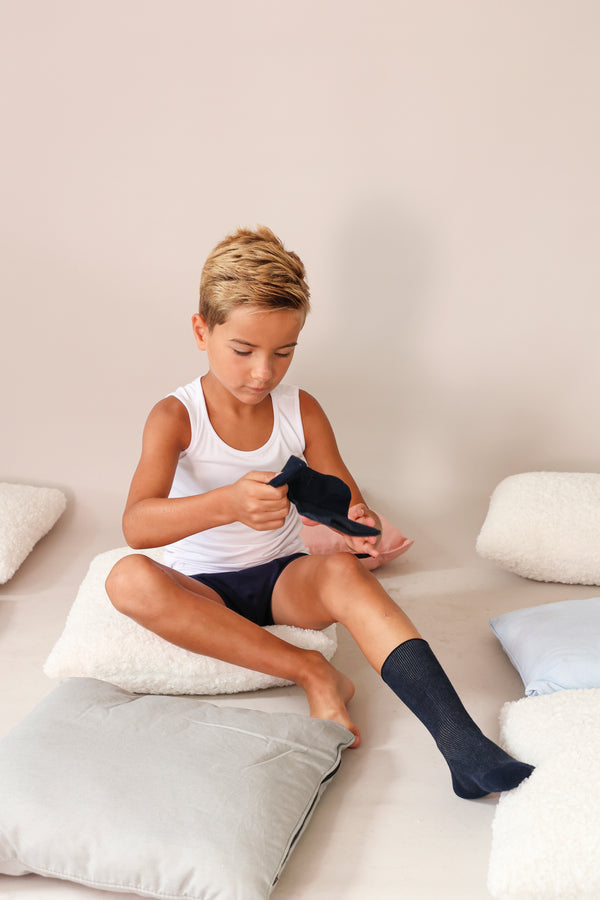
Gifted and Highly Sensitive Children: Why Getting Dressed Becomes a Battle

If your bright, intense child melts down over a sock seam or a "scratchy" shirt that looks perfectly soft to you, you're not imagining it — and it isn't misbehaviour. Many gifted and highly sensitive children experience the physical world more intensely than their peers, and clothing is one of the most common places that intensity shows up. The seam, the label, the waistband you'd never notice can feel genuinely overwhelming to them. The good news is that this is one of the easier triggers to remove. This article looks at why getting dressed becomes such a battle for these children, and what actually helps.
Why are gifted and highly sensitive children so reactive to clothing?
Gifted and highly sensitive children often have what's sometimes called heightened sensory sensitivity, or sensory overexcitability — a nervous system that registers and responds to sensory information more intensely than usual. The idea of overexcitabilities comes from research on intensity in gifted children, and it overlaps heavily with the highly sensitive trait and with sensory processing differences. So a child can be academically far ahead and still find a clothing label unbearable; the two go together more often than people expect. It isn't fragility or drama — it's a genuinely lower threshold for sensory input.
Sensory overexcitability: a heightened intensity and awareness of sensory experience, often described in gifted and highly sensitive children, where ordinary input — a seam, a tag, a texture — is felt more strongly and can become distracting or distressing. Soft, seam-free clothing reduces that input; it doesn't change the underlying sensitivity.
Why clothing in particular sets them off
Clothing is relentless: it's against the skin all day, with no break. For a child whose system is already running "louder," a constant tactile signal is hard to filter out, so it keeps pulling their attention. Dr. Elaine Aron, who first described the highly sensitive trait, notes that sensitive children process everyday stimulation more deeply, which is why something minor to others can be a big deal to them. A scratchy seam isn't a small irritation a child should just push through — it's a real, ongoing input that uses up attention and patience. Removing it gives a child more capacity for everything else. To be clear, this is about comfort, not treatment: softer clothes lower the sensory load, but they don't change a child's sensitivity or giftedness, and they're not a substitute for professional support where it's needed.

What helps: a calmer approach to getting dressed
- Start with the worst offender. For most children it's socks (the toe seam) — fix that first and you often defuse the biggest daily flashpoint.
- Switch to seam-free, tag-free, non-binding pieces in fine, soft fibres like bamboo, so there's nothing to catch on.
- Pre-wash new clothes once or twice; even good fabric feels softer and less "new" against sensitive skin.
- Offer small, bounded choices ("the grey or the navy?") so a child feels some control rather than being dressed against their will.
- Lay everything out the night before to take the time pressure out of the morning, when sensitivity is often highest.
- Believe them. Treating "it hurts" as real information rather than resistance turns the morning from a power struggle into problem-solving together.
It's not just fabric — it's seams, tags and fit
A soft fabric still won't work if there's a hard toe seam, a stiff printed label or a tight waistband, so look for seam-free, tag-free construction and a relaxed, non-binding fit as well as a gentle fibre. Our guide to fabrics that don't itch compares the gentlest materials, and if socks are the daily flashpoint, what to do when a child refuses to wear socks goes deeper. For the full picture, see our complete clothing guide for sensory-sensitive children. Many of these children stay sensitive into adulthood, so our guide for highly sensitive adults may help too.
Blusss clothing for gifted and highly sensitive children
Blusss is designed around exactly the triggers these children react to: seam-free, tag-free, non-binding, in fine soft fibres. The seamless bamboo socks remove the toe seam that so often starts the morning off badly, and the AIR FLOW bamboo tee is smooth, breathable and label-free. Across the kids' range the principle is the same: nothing that scratches, digs in or grips. The feedback we hear most from parents is simple — when the clothes stop fighting the child, the mornings calm down. Blusss makes everyday sensory-friendly clothing, not a treatment; if your child's sensitivity is affecting daily life, a paediatrician, psychologist or occupational therapist is the right person to talk to.
FAQ
Why is my gifted child so sensitive to clothing?
Many gifted and highly sensitive children have a heightened response to sensory input, so ordinary seams, tags and textures feel stronger and more distracting to them than to other children. It's a real difference in sensitivity, not fussiness.
Is sensory sensitivity the same as being gifted?
No. They're separate, but they often overlap — a child can be gifted, highly sensitive, both or neither. Heightened sensory sensitivity is simply noticed more often in gifted and highly sensitive children.
What clothing is best for a highly sensitive child?
Seam-free, tag-free, non-binding clothing in fine, soft fibres like bamboo, modal or soft organic cotton. Avoid hard toe seams, stiff labels, scratchy fabrics and tight elastic.
Is my child just being difficult about clothes?
Almost certainly not. For a sensitive child, "it hurts" usually reflects genuine discomfort. Treating it as real information, and removing the trigger, tends to work far better than pushing through.
Can soft clothing help my child focus or behave better?
It can remove one constant distraction, which many children find calming — but clothing isn't a treatment and doesn't change a child's abilities or sensitivity. Think of it as lowering the sensory load, not fixing anything.
Should I see a professional about my child's sensitivity?
If sensitivity is affecting daily life — sleep, school, eating, getting dressed — it's worth talking to a paediatrician, psychologist or occupational therapist. Comfortable clothing can help day to day, but it doesn't replace professional advice.
Key takeaways
- Gifted and highly sensitive children often feel sensory input more intensely, so clothing triggers are real — not drama.
- Sensitivity and giftedness overlap but aren't the same thing.
- Socks (the toe seam) are usually the biggest daily flashpoint — fix that first.
- Seam-free, tag-free, non-binding, soft-fibre clothing removes the trigger and lowers the sensory load.
- It's comfort, not treatment — see a professional if sensitivity affects daily life.