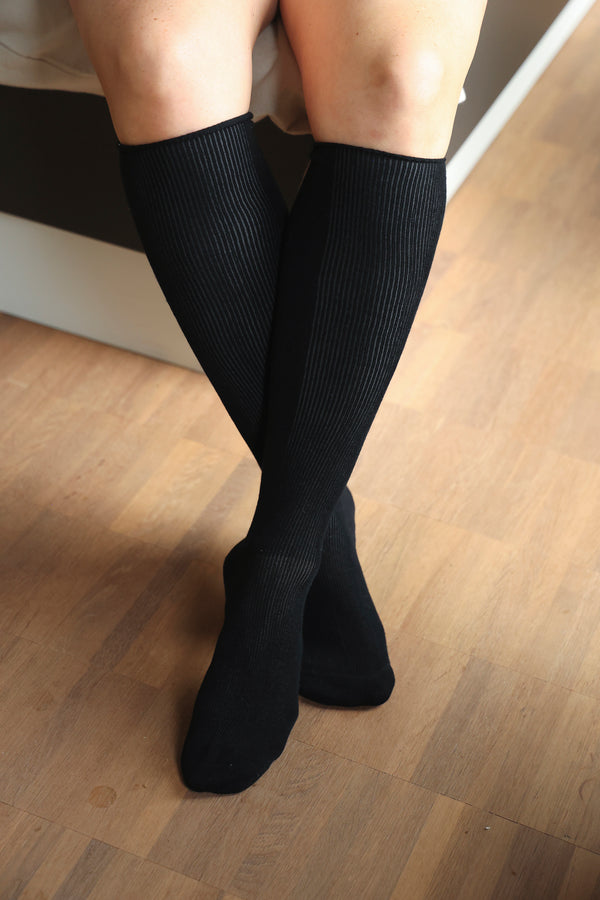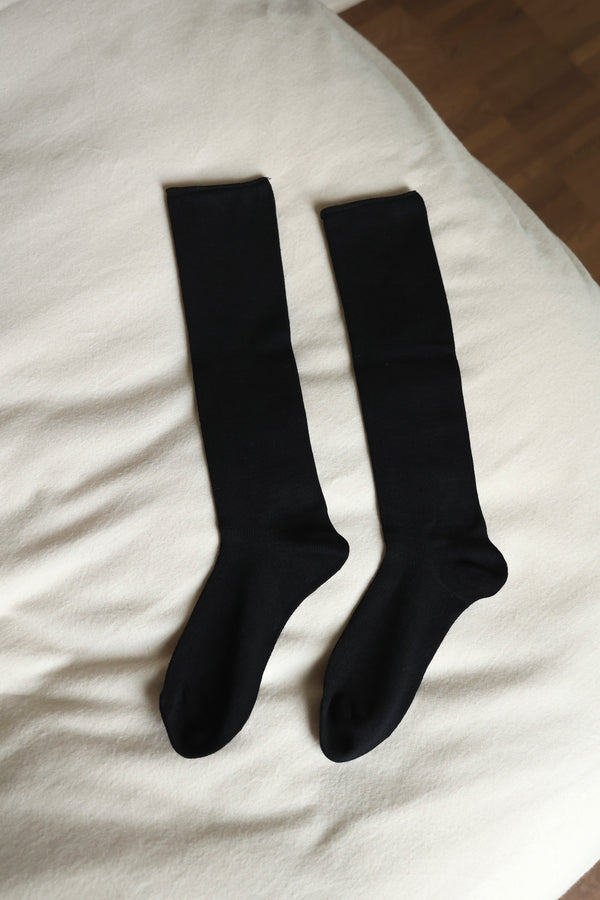
Knee-High Socks That Don't Leave Marks on Your Legs

Do your knee socks leave a red ring around your calf every evening? That mark comes from the cuff, not from your legs. A knee-high sock with a non-binding top and a seamless knit stays up without pressing into the skin. This guide explains why marks appear and what to look for instead.
A sock mark that fades within an hour is usually harmless. But if you spend the day noticing the ring, rolling the cuff down or changing socks by lunchtime, the sock is simply too tight for your legs.
Why do knee-high socks leave marks?
Knee socks leave marks because most of them stay up with a firm elastic band at the top, which presses the same narrow strip of skin all day.
The higher a sock reaches, the more it has to work against gravity. Classic knee socks solve that with a strong ribbed cuff. All the holding power sits in a band of two or three centimetres, right on the soft part of the calf. Add a long day of sitting, warm weather or slight swelling, and the ring shows up.
What are non-binding socks?
Non-binding socks keep their shape through soft, even stretch across the whole leg, instead of a tight elastic band at the top.
Non-binding: the sock has no compressing elastic in the cuff. It holds by the stretch of the knit itself, so the pressure is spread out rather than concentrated in one line.
Non-binding is not the same as compression. Compression socks are made to apply graduated pressure and are usually chosen with a healthcare professional. Non-binding socks do the opposite: they aim to add as little pressure as possible.
5 checks for knee socks that leave no marks
The best knee-high socks for marks and pressure lines are non-binding, seamless, smooth, breathable and true to size. Check these five points:
- The cuff: soft and wide, with even stretch rather than a firm ribbed band.
- The seams: a flat or seam-free toe, so nothing rubs inside your shoe.
- The knit: smooth and consistent, so it does not bunch behind the knee or at the ankle.
- The fabric: soft and breathable, such as bamboo, which helps regulate warmth and moisture.
- The size: based on your shoe size. A sock that is too small stretches to its limit and digs in everywhere.
Who benefits most from non-binding knee socks?
Non-binding knee socks help anyone whose legs react quickly to pressure, from swelling to sensitive skin.
- People with swollen feet, ankles or calves at the end of the day, or during warm weather.
- People with diabetes or neuropathy, who are often advised to avoid socks that constrict the leg and to check their skin daily.
- People with sensitive or reactive skin, where a tight cuff quickly causes itching or irritation.
- People who experience touch intensely and notice a sock band all day long.
- Anyone who sits, stands or travels for long stretches.
If you are managing a health condition, your doctor or podiatrist can tell you which type of sock suits you. This article is about comfort, not treatment.
When is a sock mark worth checking?
A mark that disappears within an hour is common. It is worth speaking to a doctor if a mark stays visible for a long time, if the skin breaks, or if one leg swells noticeably more than the other.
The same goes for numbness, tingling or a cold foot after wearing socks. Those are signals about circulation rather than about the fabric.
Seamless knee-high socks from Blusss
Blusss knee-high socks are knitted from soft bamboo without a toe seam and without a tight ribbed cuff, so they stay up without leaving marks on your legs.
They come in sizes 27–46, so the same pair works for teens and adults. Browse the seamless knee-high socks, or read more about non-binding socks for swollen feet and ankles.
Key takeaways
- Marks come from a tight cuff, not from your legs being the wrong shape.
- Non-binding socks spread the pressure through the knit instead of one band.
- A mark that lingers, broken skin or one swollen leg is worth discussing with a doctor.
FAQ
Why do my socks leave marks on my legs?
Because the elastic cuff holds the sock up by squeezing a narrow strip of skin. The tighter the band, the deeper the mark, especially if your legs swell during the day.
Are sock marks a sign of poor circulation?
Not on their own. Marks are usually about the sock. Talk to a doctor if the mark stays for hours, if the skin breaks, or if one leg swells much more than the other.
What are non-binding knee-high socks?
Socks that stay up through the soft stretch of the knit rather than a tight elastic band, so the pressure is spread out instead of concentrated at the top.
Are non-binding socks the same as compression socks?
No. Compression socks apply deliberate, graduated pressure and are usually chosen with a healthcare professional. Non-binding socks aim to add as little pressure as possible.
Do knee socks without elastic stay up?
Yes, when the whole sock has even stretch and the size is right. The holding power is spread along the leg instead of packed into the cuff.
Which fabric is best for knee socks that leave no marks?
Soft, breathable fabrics such as bamboo feel smooth on the skin and help regulate warmth and moisture, which matters when a sock covers the leg all day.