Tag-Free and Seamless Clothing: Why Labels and Seams Bother Sensitive People

For a lot of people, a clothing label is something you cut off once and forget. For someone with tactile sensitivity, a stitched-in tag or a thick seam can be impossible to ignore — a small, constant scratch that pulls at your attention all day. It is one of the most common reasons people look for tag-free and seamless clothing. This guide explains why labels and seams bother sensitive people so much, what makes a garment genuinely tag-free and seamless, and how to recognise the real thing.
Why do tags and seams bother sensitive people so much?
Tags and seams bother sensitive people because they create a small, repeating point of friction that the brain keeps noticing instead of filtering out. A care label rubs at the back of the neck; a thick seam presses along the shoulder, side or toes. For many people — especially those with sensory sensitivities — that signal doesn't fade into the background the way it does for others. It stays present, and staying present is what makes it draining. A 2021 study in the Journal of Autism and Developmental Disorders explored how clothing and tactile sensitivity are experienced day to day. Removing the tag and the seam simply takes the signal away. Looking for this from a child's point of view? Read why clothing tags are so irritating for sensory-sensitive children.
Tactile sensitivity: experiencing touch more intensely than average, so textures, seams and labels that others barely register can feel uncomfortable or even overwhelming. It is a difference in how the nervous system processes touch, not a sign of being “fussy” — and it is why a tag or seam can feel impossible to tune out.
What makes clothing genuinely tag-free and seamless?
Genuinely tag-free and seamless clothing has the care information printed directly onto the fabric and is built so that seams lie flat or disappear altogether. A printed label means there is no stiff tag sewn into the neck or waist. A seamless or flat-seam construction means the joins are knitted together or bonded flat, instead of a raised ridge stitched on the inside. The result is a garment with nothing hard pressing or rubbing against the skin — which is exactly what makes it easy to forget you are wearing it. For a deeper look at construction and materials, see our complete guide to seamless clothing.

How to spot genuinely tag-free, seamless clothing
Not everything labelled “soft” is actually tag-free or seamless. Before you buy, this is what to check.
- Look for a printed or heat-transferred care label, not a stiff tag sewn into the neck or waistband.
- Turn the garment inside out and feel the seams — they should be flat or barely there, with no raised ridge.
- Check the shoulder, underarm and side seams, the spots that rub most during movement.
- For socks, feel the toe; for underwear, check the waistband and leg edges.
- Choose a soft, fine-fibre fabric like bamboo viscose or organic cotton, so the whole surface feels smooth.
- Make sure the fit is relaxed, so seams and edges aren't pressed hard against the skin.
Which fabrics make tag-free clothing feel even better?
Removing tags and seams solves the hard points; a soft fabric makes the rest of the garment just as gentle. Fine, smooth fibres like bamboo viscose and organic cotton bend against the skin instead of prickling, and they breathe well so they don't feel hot or clammy. A seamless T-shirt in a scratchy fabric still won't feel right, which is why fabric and construction matter together. Our guide to which fabrics don't itch goes deeper on the gentlest options.
Blusss tag-free, seamless clothing
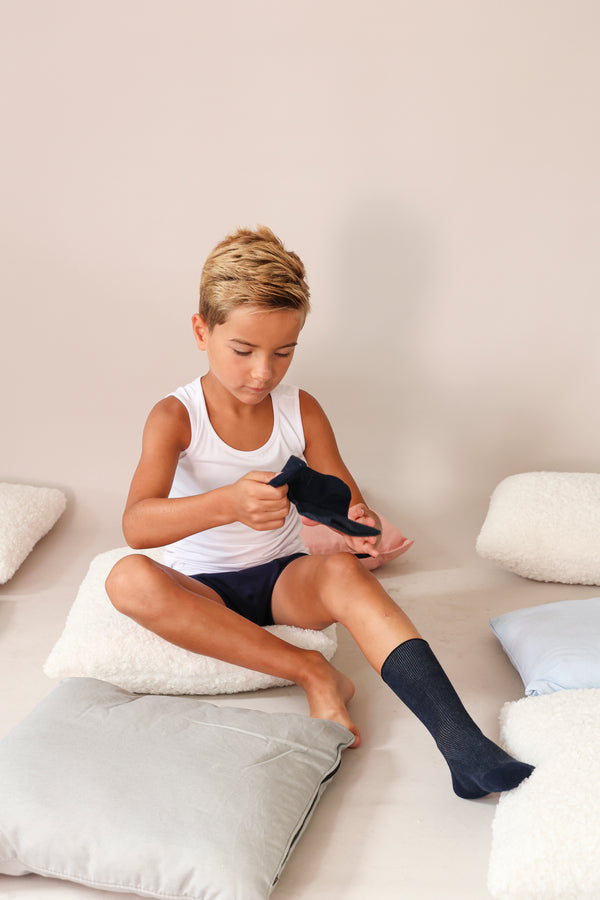
Every Blusss piece is designed tag-free and seam-free from the start. The AIR TEE and the AIR LONG bamboo long sleeve have printed labels and smooth, seam-free bodies; the SENSE seam-free underwear and the seamless bamboo socks remove the seams and edges that rub most. After years of designing seam-free, tag-free clothing with and for sensory-sensitive adults, our consistent experience is that a printed label and a flat seam are the two changes people notice first.

FAQ
What does tag-free clothing mean?
It means the care information is printed onto the fabric instead of being on a stiff label sewn into the neck or waistband, so there is no tag to scratch or irritate.
Why do clothing tags irritate some people so much?
A sewn-in tag rubs the same spot constantly, and people with tactile sensitivity notice that signal far more than others, so it can feel like an itch that never stops rather than a minor detail.
Is seamless clothing the same as tag-free?
Not quite. Seamless refers to how the garment is joined — flat or without raised seams — while tag-free refers to the label. The most comfortable pieces are both.
How can I tell if clothing is really seamless?
Turn it inside out and run a finger along the shoulder, side and underarm seams. If you feel a hard raised ridge, it isn't truly flat; a genuinely seamless piece feels smooth.
Can I remove a tag to make clothing comfortable?
Cutting out a tag helps, but it often leaves a stiff stub or small holes that still rub. Clothing designed tag-free from the start avoids that completely.
Is tag-free, seamless clothing only for autistic people?
No. It suits anyone with tactile sensitivity, sensitive or reactive skin, or simply a low tolerance for scratchy labels and seams.
Key takeaways
- Tags and seams bother sensitive people because they create a constant point of friction the brain keeps noticing instead of filtering out.
- Genuinely tag-free clothing has a printed label; genuinely seamless clothing has flat or bonded seams with no raised ridge.
- Check by turning a garment inside out and feeling the neck, shoulders, sides, toes and waistband.
- Soft, fine fibres like bamboo and organic cotton make tag-free, seamless pieces feel even gentler.
- It suits anyone with tactile sensitivity or sensitive skin, not only autistic people.